2026.06.16: Beekeeping, year #4
2026-06-16 09:05 by Ian

Winter was mild. All three of my hives survived.
I fed them a bunch of sugar and synthetic pollen so they could get a head-start on buffing their numbers. This appears to have worked really well. By the time the silver maples were blooming, all but one hive was at full strength.
The hive I captured last season is shaping up to be the strongest producer. Summer isn't over yet, and there are already two supers full of capped honey. My mentor and I have decided to put them to work filling out vacant frames with comb.
A little biochemistry...
The principle ingredient in beeswax are langth-variations of this molecule.
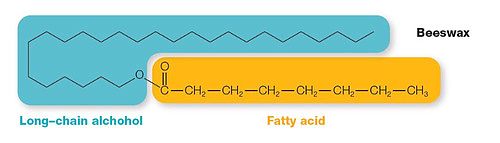
Bees make wax from honey, which is almost entirely monosaccharides (5 or 6 carbons per mol). The fatty acid component of the wax accounts for 8 carbons, and the long-chain alcohol has 26 (34 total carbons). If the bees are making wax entirely from glucose, that means that it can't possibly cost them less than 6 mol of glucose per mol of wax, structurally. Likely a few more after metabolic costs. Saturation of every carbon in the wax should produce water as a byproduct of dehydrating the sugars. I might do the thermochem calculations later, but I can already tell that is a tremendous energy cost.
I don't know the exact steps in the synthesis, but I'd guess that the caboxlyic acid, and the long-chain alcohol are anabolized separately, and joined as an ester as a final step, producing an additional mol of water from the condensation.
When the hive is doomed...
A hive deprived of their queen will begin making panic preparations to convert suitably-young larve into queens. But if those measures fail, the hive (absent human intervention) will be unable to produce any more female bees, and is thus doomed.
I actually saw this happen in one of our experimentation hives this season. Under these conditions, a worker bee might begin laying eggs. But since she was never fertilized, she can only produce drones in a hail-mary attempt to save the genes of the hive through paternal export.
Introducing a queen at this point is much easier, but first, the laying females need to be removed from the hive. My mentor did this by removing all of the bees from the hive, and placing the hive in a position where the bees would need to fly to re-enter. But the laying females, being too swollen with eggs, are unable to make even a short flight to rejoin the hive. Indeed, after he did this, all but a single bee had re-entered the hive.
Previous: That time I unwittingly prevented a knife-point robbery
Next: The root of my antipathy for Microsoft